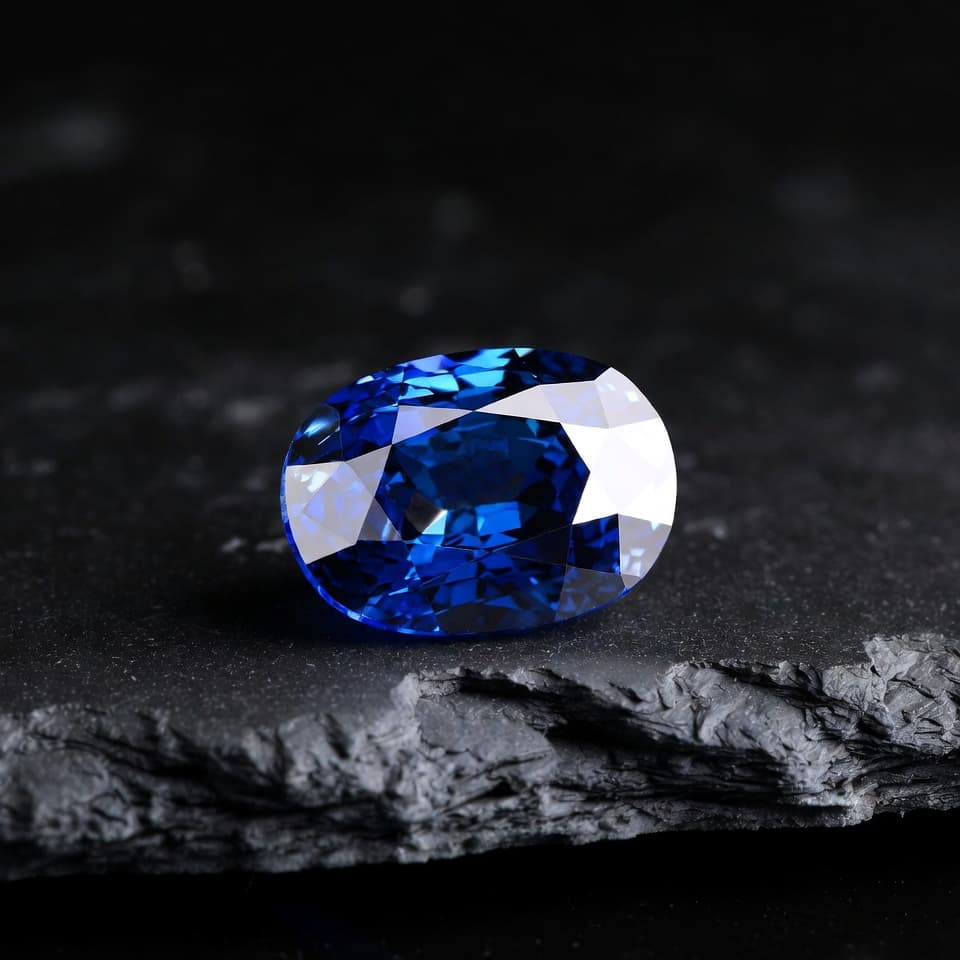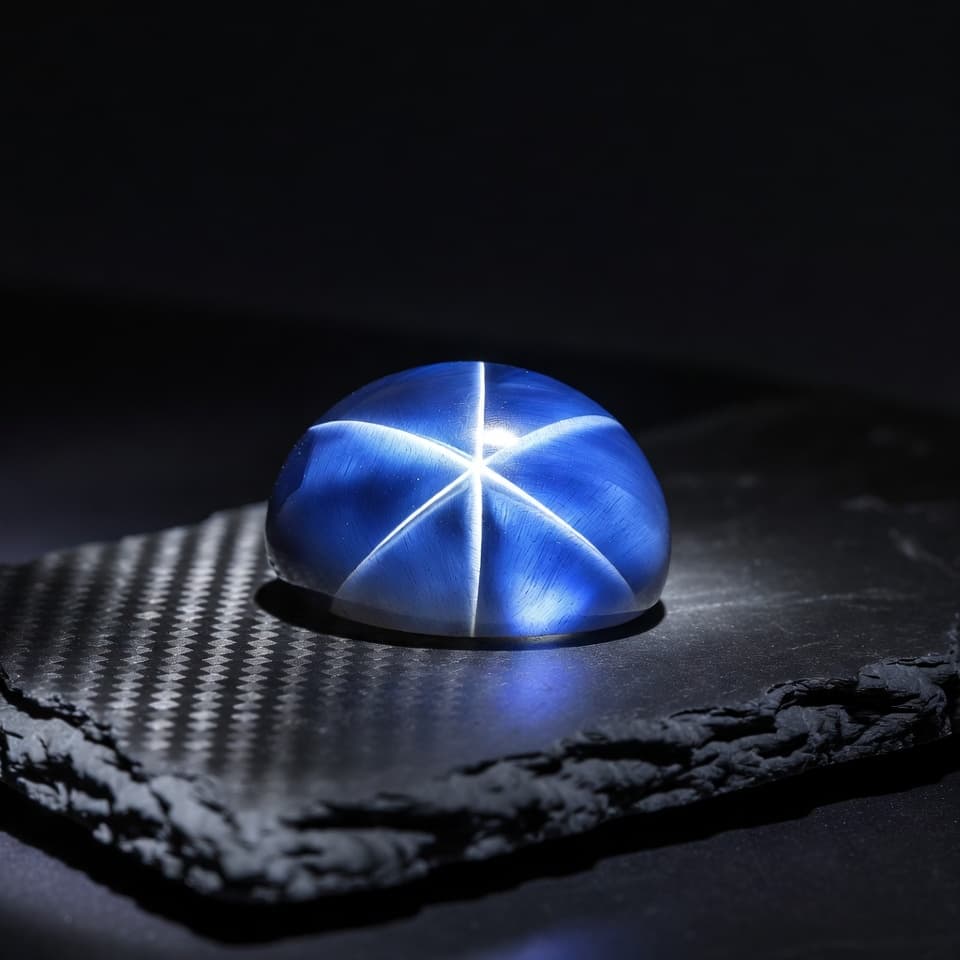
Several blue gemstones resemble sapphire closely enough to be confused with it by eye, and one of them, laboratory-grown corundum, is chemically and optically identical to the natural stone. Distinguishing them is a matter of measured properties, not appearance.
No buyer should be expected to make these calls unaided. The point of understanding them is to know which questions to ask, and to recognise that an independent laboratory report is the only conclusive answer.
Blue spinel
Spinel is a separate mineral species that occurs alongside sapphire in the same Sri Lankan gravels, and the two were routinely confused for centuries. Spinel is 8 on the Mohs scale against sapphire's 9, and it is singly refractive where sapphire is doubly refractive. That optical difference is decisive and easily measured, but it is invisible to the naked eye. Fine spinel is a desirable stone in its own right and is not a substitute or an imitation.
Tanzanite
Tanzanite is strongly trichroic, meaning it shows three different colours depending on the viewing direction, typically blue, violet and a brownish or burgundy tone. Sapphire can be dichroic but never to that degree. Tanzanite is also much softer, around 6 to 7, and it has cleavage, which corundum does not. Those two facts together make it a poor choice for a ring worn daily, whatever its colour.
Iolite
Iolite is markedly pleochroic, shifting from violet-blue to a pale straw or grey as it is turned, an effect so pronounced it is visible without instruments. It is 7 to 7.5 on the Mohs scale. Held still and viewed from the right angle it can pass for a sapphire; turned in the hand it rarely does.
Laboratory-grown sapphire
This is the case that cannot be resolved by eye or by simple measurement. Laboratory-grown corundum has the same chemical composition, the same hardness, the same refractive index and the same specific gravity as natural sapphire, because it is sapphire. It differs only in origin. Identification rests on inclusions and growth features, which is laboratory work requiring magnification and, in some cases, spectroscopy.
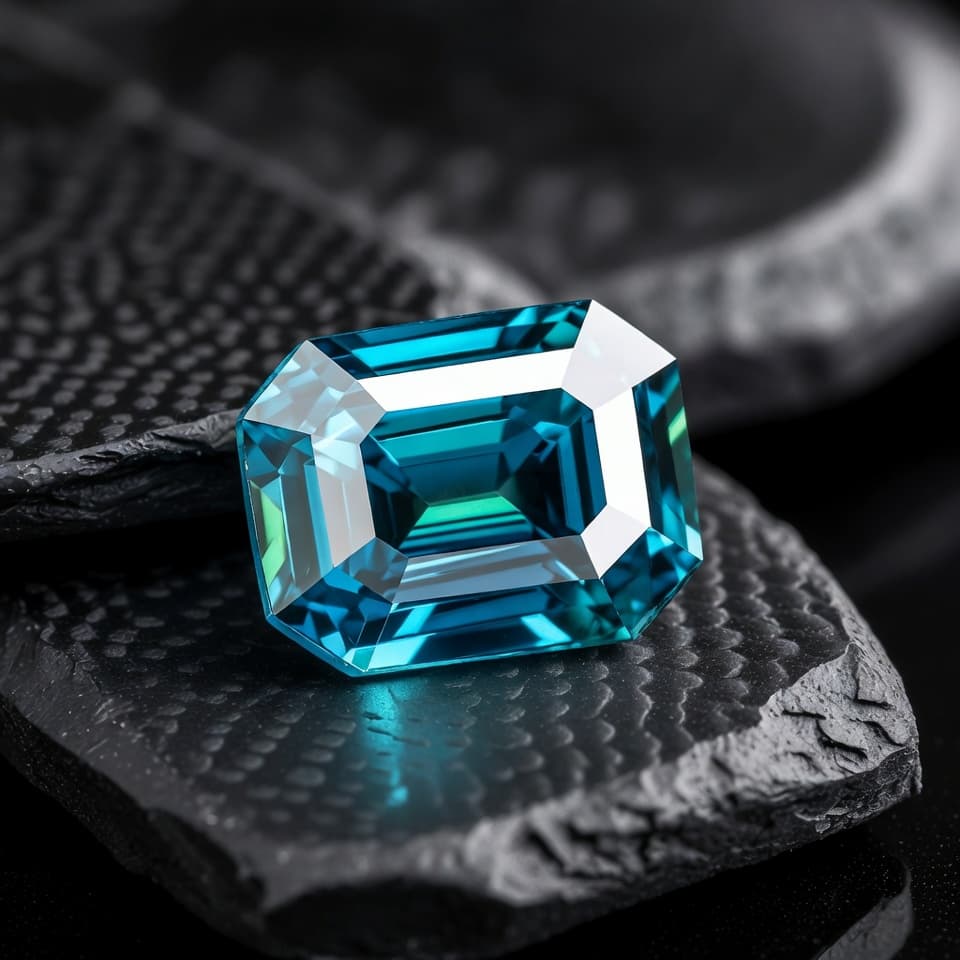
Laboratory-grown sapphire is not a fake. It is real sapphire that formed in a factory rather than in the ground. The distinction is origin, and it must be disclosed.
Glass, doublets and composites
Glass is the oldest imitation and the easiest to detect: it is warm to the touch relative to a gemstone, far softer, and typically contains rounded gas bubbles rather than the angular crystalline inclusions found in natural stone. Doublets, in which a thin slice of genuine material is cemented to a cheaper base, are detected by examining the stone side-on for a join plane.
What separates them, in short
- Hardness: sapphire 9, spinel 8, iolite 7 to 7.5, tanzanite 6 to 7.
- Optical character: sapphire doubly refractive, spinel singly refractive.
- Pleochroism: strong and obvious in iolite and tanzanite, weak in sapphire.
- Cleavage: present in tanzanite, absent in corundum.
- Natural against laboratory-grown sapphire: identical in every physical property, separated only by inclusions and growth structure.
Why the report is the answer
Every distinction above is measurable, and none of them is reliably visible across a counter. An independent laboratory report identifies the species, states whether the material is natural or laboratory-grown, and reports any treatment. For any stone of consequence, that report is not an optional extra, it is the basis of the transaction.
Frequently asked questions
- How can you tell sapphire from blue spinel?
- Sapphire is doubly refractive and 9 on the Mohs scale; spinel is singly refractive and 8. The optical difference is conclusive but requires instruments. The two occur together in Sri Lankan gravels and were confused for centuries.
- Is tanzanite a good substitute for sapphire in a ring?
- Not for daily wear. Tanzanite is 6 to 7 on the Mohs scale and has cleavage, where sapphire is 9 with none. It is better suited to earrings and pendants, which take far less impact.
- Can you tell a laboratory-grown sapphire by eye?
- No. Laboratory-grown corundum is chemically and optically identical to natural sapphire. Identification depends on inclusions and growth features under magnification, which is laboratory work.
- Is a laboratory-grown sapphire a fake?
- No. It is genuine sapphire that was grown rather than mined. It is not an imitation, but it is a different product with a different value, and it must be disclosed as laboratory-grown.
- How do you identify glass imitating sapphire?
- Glass is much softer, feels warm relative to a gemstone, and typically contains rounded gas bubbles rather than the angular crystalline inclusions seen in natural corundum.
Sources
- GIA, Sapphire Description and Quality Factors
- Standard gemmological property tables: refractive index, specific gravity, optical character
- Laboratory practice on natural against laboratory-grown corundum identification